What Is Tokenization?
The tokenization of real-world assets (RWAs) is one of the most transformative trends in modern finance, leveraging blockchain technology to digitize ownership of physical and financial assets. By converting rights to assets such as real estate, bonds, art, and commodities into digital tokens, tokenization enables fractional ownership, 24/7 trading, and automated compliance. This innovation bridges the gap between traditional finance and decentralized ecosystems, promising to democratize access to investment opportunities and redefine asset management.
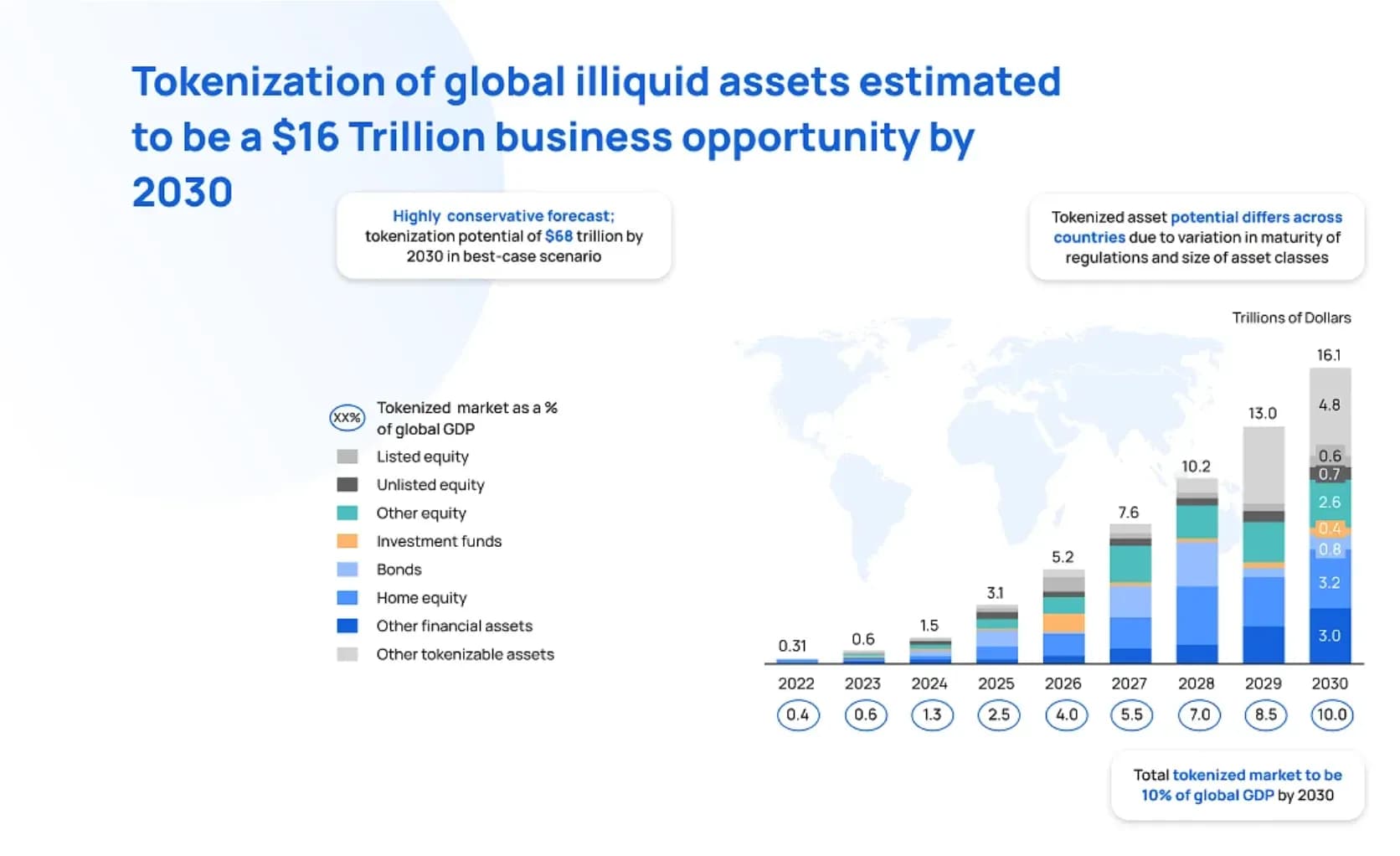
The market for tokenized assets has experienced rapid growth in recent years. As of 2024, the total value of tokenized assets reached approximately $176 billion, with projections estimating growth to $16 trillion by 2030 and potentially $30 trillion by 2034. (Aleksandrov & Aloshyna, 2025). A joint report by Boston Consulting Group and ADDX estimates that tokenization of global illiquid assets alone represents a $16 trillion market opportunity by 2030 (ADDX, 2022). This expansion is driven by rising institutional and retail participation, advancements in blockchain infrastructure, and increasing regulatory clarity. As adoption accelerates, tokenization is reshaping capital markets and challenging traditional notions of ownership, investment, and value transfer.
How Tokenization Works
Tokenizing a real-world asset involves several structured steps to ensure the digital token accurately and legally represents the underlying asset:
- Asset Selection and Valuation: A suitable asset, such as real estate, private credit, or bonds, is identified and professionally valued to determine its market worth.
- Legal Structuring: A legal entity, commonly a Special Purpose Vehicle (SPV), is established to hold the asset. This structure ensures regulatory compliance and creates a clear legal link between off-chain ownership and on-chain tokens. Oracles or proof-of-reserve mechanisms are often used to verify the asset's existence and backing.
- Token Issuance: Digital tokens are minted using smart contracts on a blockchain network such as Ethereum, Polkadot, or permissioned ledgers. Tokens may be fungible (e.g., ERC-20 for fractional ownership) or non-fungible (e.g., ERC-721 for unique assets).
- Distribution and Trading: Tokens are distributed to investors, typically subject to KYC/AML requirements. Once issued, they can be traded on secondary markets, used as collateral in decentralized finance (DeFi) protocols, or redeemed for claims on the underlying asset.
Key Benefits Driving Adoption
Tokenization addresses long standing inefficiencies in traditional financial systems. Fractional ownership democratizes access by allowing investors to purchase small shares of high value assets such as commercial real estate or fine art. Liquidity improves significantly through 24/7 trading and near-instant settlement, in contrast to the delays and frictions of legacy markets.
Blockchain's immutable ledger enhances transparency and reduces fraud, while smart contracts automate administrative processes, lowering costs and minimizing the need for intermediaries. Additionally, borderless participation removes geographic barriers to investment, and seamless DeFi integration enables RWAs to function as stable collateral, offering yield and diversification amid cryptocurrency market volatility.
Prominent Use Cases and Institutional Involvement in 2025
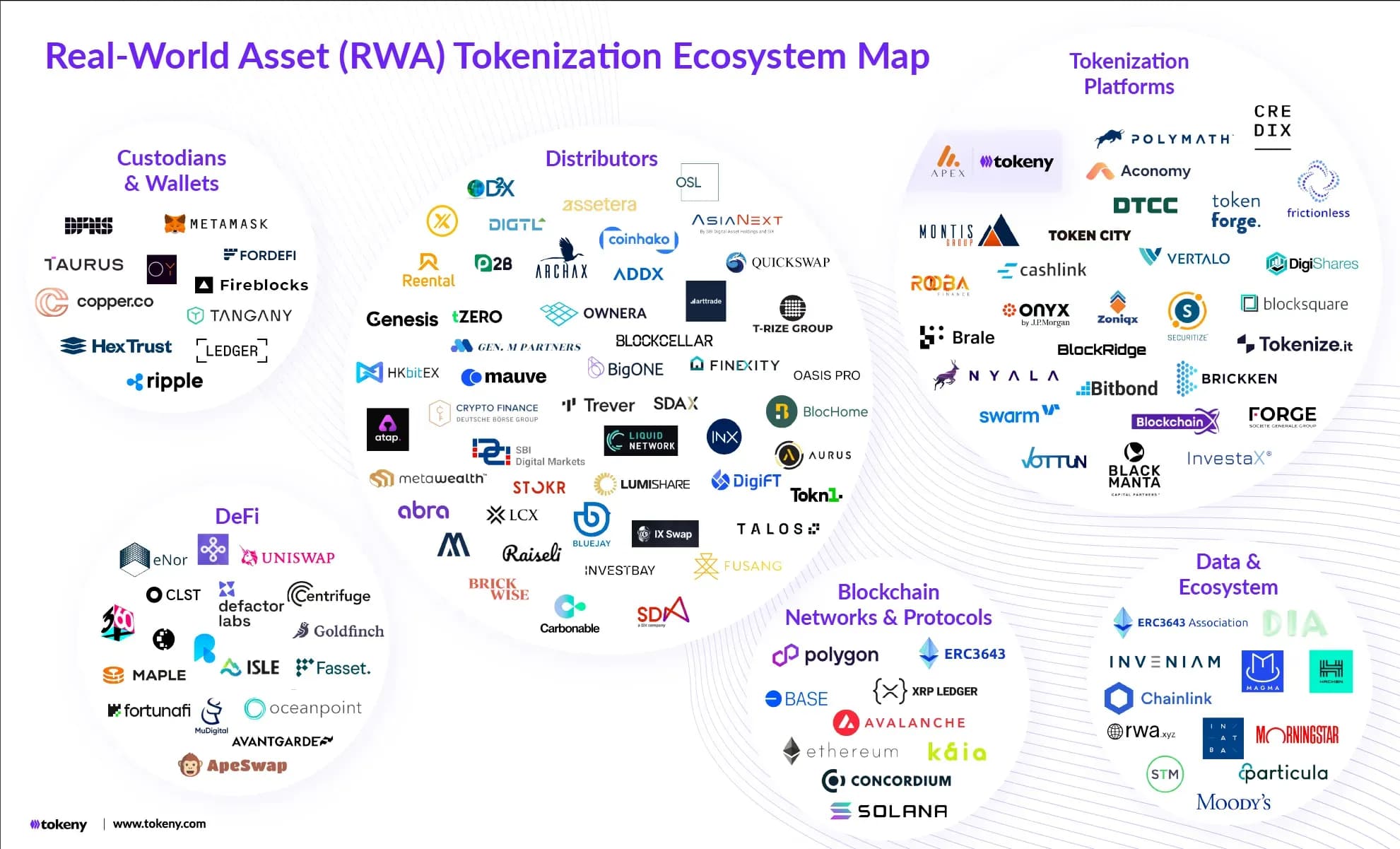
By 2025, tokenized U.S. Treasuries and money market funds have emerged as leading use cases. BlackRock's BUIDL fund has approached $3 billion in assets under management, maintaining a dominant share of the tokenized Treasury market. Platforms such as Ondo Finance, Franklin Templeton, and Centrifuge have collectively tokenized billions of dollars in private credit, loans, and fixed-income products.
Real estate tokenization continues to advance through fractional ownership models, while commodities, such as tokenized gold via XAUT, and emerging sectors like carbon credits are gaining traction. Major financial institutions, including Goldman Sachs, JPMorgan, DBS Bank, and Binance, are actively engaged through token issuance, custody services, and integration of RWAs as collateral. These developments reflect a deepening convergence between traditional finance and on-chain ecosystems.
Key Players and Prominent Projects in 2025
Several institutions and protocols are at the forefront of real-world asset tokenization, driving innovation through compliance-focused infrastructure, yield generation, and institutional-grade products:
- BlackRock (BUIDL Fund): In partnership with Securitize, BlackRock leads the tokenized Treasury market with billions of dollars in assets, offering regulated, yield-bearing instruments on-chain and setting a benchmark for institutional adoption.
- Franklin Templeton: Through its OnChain U.S. Government Money Fund (BENJI/FOBXX), Franklin Templeton provides tokenized exposure to money market funds and Treasuries, expanding access for both institutional and retail investors.
- Ondo Finance: A decentralized leader in tokenized fixed-income products such as OUSG and USDY, Ondo bridges compliant real-world assets with DeFi liquidity, managing billions in total value locked.
- Centrifuge: Specializing in private credit and real-world assets such as invoices and receivables, Centrifuge has surpassed $1 billion in total value locked, enabling institutional-grade lending pools within DeFi.
- MakerDAO: By integrating RWAs as collateral for DAI, MakerDAO has incorporated significant Treasury and credit exposure into its vaults, strengthening protocol stability while attracting traditional capital.
Conclusion
Real-world asset tokenization is poised to redefine global finance by unlocking trillions of dollars in value through enhanced liquidity, interoperability, and inclusive access. As blockchain infrastructure matures and regulatory frameworks continue to evolve, RWAs will increasingly serve as the connective layer between traditional financial markets and decentralized innovation. Over the coming decade, tokenization is expected to foster a more transparent, efficient, and equitable financial system.
Real-world asset tokenization is poised to redefine global finance by unlocking trillions of dollars in value through enhanced liquidity, interoperability, and inclusive access.