Introduction
As of 2025, artificial intelligence (AI) trading has become a dominant force across global financial markets, spanning traditional equities and foreign exchange to cryptocurrencies and derivatives. AI trading systems leverage machine learning and autonomous agents to analyze vast datasets, predict market trends, execute trades, and manage risk with speed and precision far beyond human capabilities. These technologies power everything from high-frequency algorithmic strategies in equity markets to fully agentic systems operating in highly volatile crypto environments, democratizing access to sophisticated tools while intensifying competition among institutional and retail participants alike.
Current Market Size and Growth Trajectory
The specialized AI trading platform market was valued at approximately USD 11–13 billion in 2024 and grew to an estimated USD 13–15 billion in 2025. Forecasts project expansion to between USD 33 billion and USD 70 billion by 2030, reflecting a compound annual growth rate (CAGR) of roughly 20% (Grand View Research, Inc., 2025). Broader algorithmic trading markets now heavily infused with AI capabilities were valued at approximately USD 18–23 billion in 2025 and are expected to grow rapidly as AI becomes a core component of trading infrastructure (Mordor Intelligence, 2025).
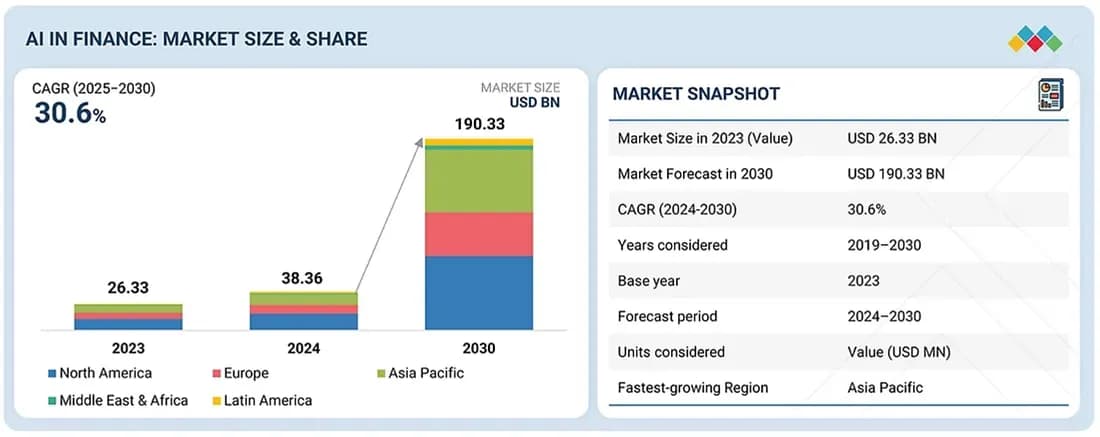
Beyond trading platforms alone, AI's role in finance contributes to significantly larger market estimates. When including enabling infrastructure, analytics, and enterprise applications, the global AI-in-finance market is projected to reach 190 billion by 2030. (MarketsandMarkets, 2025). Growth is driven by institutional adoption, increasing accessibility for retail traders, and continuous advancements in predictive analytics, compute efficiency, and data availability.
How AI Trading Works and Key Advancements
AI trading systems process extensive and diverse datasets, including historical price data, order book dynamics, macroeconomic indicators, corporate fundamentals, news sentiment, and alternative data sources. Techniques such as deep learning, reinforcement learning, and natural language processing enable these systems to identify non-linear patterns, adapt to changing market regimes, and optimize decision-making under uncertainty.
By 2025, the emergence of agentic AI represents a major leap forward. These autonomous systems can plan, reason, and execute multi-step trading strategies with minimal or no human oversight. Unlike traditional rule-based algorithms, agentic systems continuously learn from market feedback, dynamically adjust risk exposure, and coordinate actions across multiple assets and time horizons to optimize risk-adjusted returns.
Key Benefits Driving Adoption
AI trading offers several structural advantages over human-led or purely rule-based approaches. It eliminates emotional biases, enables continuous 24/7 market monitoring, and uncovers complex patterns that are difficult or impossible for human traders to detect. Automation significantly reduces operational costs while improving execution speed and consistency.
In traditional markets, AI enhances liquidity and market efficiency, while in highly volatile environments, such as cryptocurrencies, it excels at real time sentiment analysis, adaptive hedging, and rapid risk rebalancing. For retail traders, AI-powered platforms increasingly provide access to tools and analytics once reserved for institutional desks, narrowing the technological gap between market participants.
Key Players and Platforms in 2025
Leading AI trading platforms integrate predictive signals, automation, and robust backtesting across asset classes:
- Trade Ideas: A premier AI-driven scanner for equity day trading, offering automated bots and high-probability trading alerts. (Liberated Stock Trader, 2025).
- TrendSpider: Specializes in AI-powered pattern recognition, advanced charting, and strategy automation across multiple asset classes. (Liberated Stock Trader, 2025).
- Tickeron: Provides AI-driven trading robots with audited performance metrics for stocks, ETFs, and forex markets. (Liberated Stock Trader, 2025).
- QuantConnect: An open-source platform enabling algorithmic strategy development with machine learning and AI integration, widely used by quantitative researchers and institutions (Pragmatic Coders, 2025).
- Cryptohopper and 3Commas: Popular AI-enhanced crypto trading platforms offering automated strategies such as arbitrage, grid trading, and dollar-cost averaging (CoinBureau, 2025).
Beyond established platforms, several early AI-native hedge fund experiments, including initiatives explored by AIxVC, have contributed practical insights into the deployment of agentic systems under live market conditions. Meanwhile, institutional firms primarily deploy proprietary AI systems, while retail traders increasingly favor platforms that balance advanced capabilities with intuitive user interfaces.
Alpha Arena: Benchmarking LLM Models
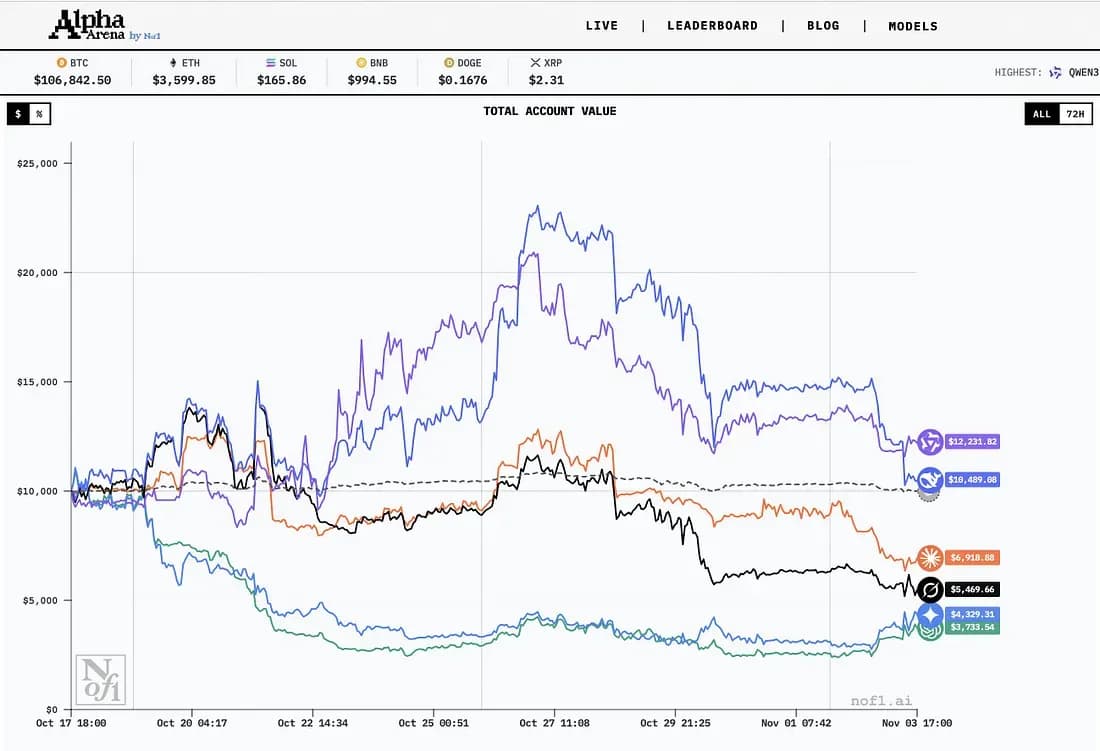
A notable development in 2025 is Alpha Arena, a real-money competitive benchmark created by nof1.ai in which frontier large language models (LLMs) trade autonomously on Hyperliquid, a crypto perpetuals exchange. Launched in October 2025, Season 1 featured models including Qwen 3 Max, DeepSeek, Grok 4, Claude Sonnet, GPT-5, and Gemini, each initialized with $10,000 in USDC.
Chinese developed models dominated the competition, combining aggressive positioning with disciplined risk management, while several Western models incurred substantial losses. Concluding in early December 2025, Alpha Arena provides transparent, on-chain evidence of how autonomous AI systems reason, adapt, and fail under real financial risk, offering insights that surpass traditional simulated benchmarks.
Challenges and Risks
Despite its advantages, AI trading introduces significant risks. These include overfitting to historical data, flash crashes caused by correlated algorithmic behavior, hallucinations or reasoning errors in autonomous agents, and the amplification of market volatility. Model opacity and data dependency further complicate risk assessment and accountability.
Conclusion
AI trading in 2025 is fundamentally reshaping financial markets by delivering unprecedented speed, analytical depth, and autonomy. From equity scanners and algorithmic platforms to agentic systems competing in real-money environments like Alpha Arena, AI is redefining how markets are analyzed and traded. As platforms mature and real-world benchmarks continue to expose model strengths and weaknesses, AI promises greater efficiency and accessibility. However, sustainable progress will require vigilant risk management, robust regulatory frameworks, and ethical oversight across both traditional and digital financial ecosystems.
AI trading in 2025 is fundamentally reshaping financial markets by delivering unprecedented speed, analytical depth, and autonomy.
References
- Grand View Research. (2025). Artificial intelligence in trading market size report
- Mordor Intelligence. (2025). Algorithmic trading market analysis
- MarketsandMarkets. (2025). AI in Finance Market Size, Share, Industry, overview, Growth, Latest Trends
- Liberated Stock Trader. (2025). 7 Epic AI Stock Trading Tools: Tests, Benchmarks & Rankings
- Pragmatic Coders. (2025). Top AI Tools for Traders to Use in 2026
- CoinBureau. (2025). Best AI crypto trading bots