Tokenised securities have entered the infrastructure phase
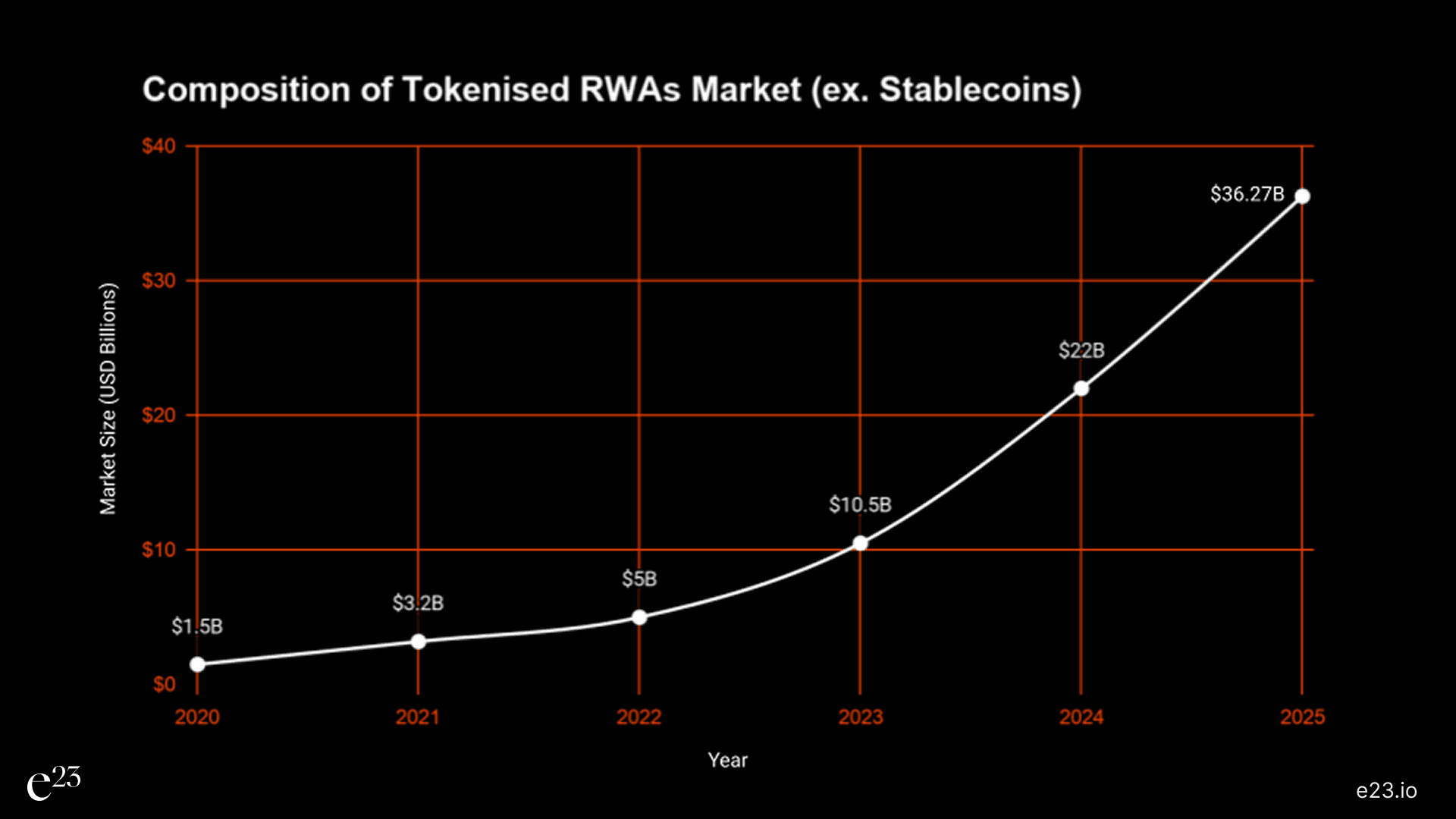
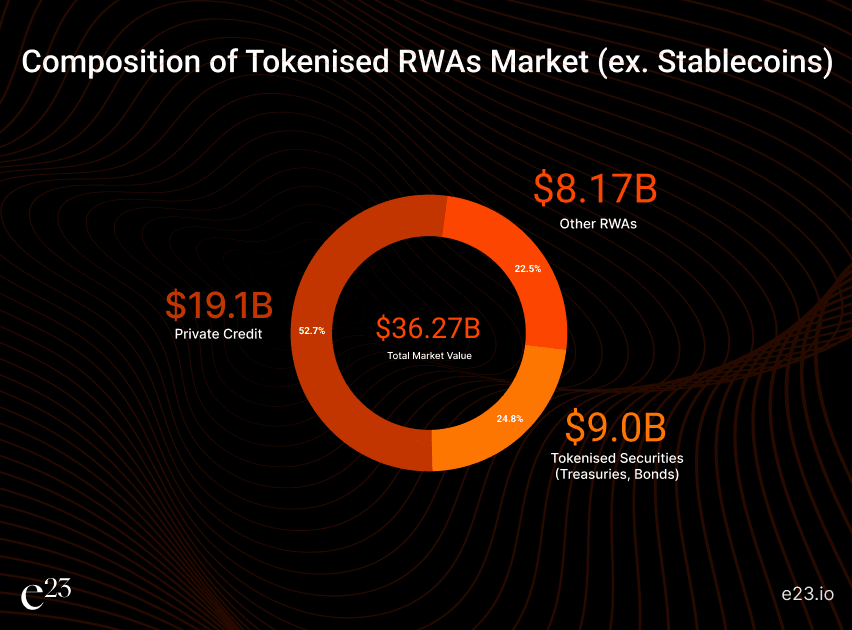
Tokenised securities have rapidly evolved from on-chain experiments into a growing segment of global financial infrastructure. Across capital markets, traditional assets such as government bonds, private credit facilities, investment funds and commodities are increasingly being issued and distributed through blockchain-based systems. According to on-chain data, the value of tokenised real-world assets (RWAs) surpassed $36B globally in 2025, reflecting strong growth driven largely by institutional financial products rather than purely crypto-native assets.
Private credit currently represents the largest segment of tokenised RWAs, while tokenised U.S. Treasuries have emerged as one of the fastest growing categories, surpassing $10B in on-chain value as asset managers experiment with blockchain-based distribution models.
The rapid expansion of tokenised assets indicates that tokenisation is gradually becoming a new infrastructure layer for capital markets. Rather than replacing traditional finance, tokenised securities introduce programmable financial infrastructure capable of improving settlement efficiency, transparency and market accessibility. By representing securities digitally on blockchain networks, financial institutions can enable faster settlement, automated compliance and fractional ownership structures that broaden investor participation across markets.
Institutional Adoption Is Driving the Growth of Tokenised Securities
The current phase of tokenisation is increasingly driven by traditional financial institutions. Global asset managers and banks have begun issuing tokenised versions of treasury funds, credit instruments and investment vehicles that operate directly on blockchain rails. Products such as tokenised Treasury funds and tokenised private credit markets demonstrate how financial institutions are experimenting with digital distribution models that allow investors to access traditional assets through programmable financial infrastructure.
This institutional participation is significant because it signals that tokenisation is transitioning from proof-of-concept experimentation toward operational capital market infrastructure. Tokenised securities allow financial assets to exist in programmable digital form, enabling automated settlement processes and transparent ownership records. For institutions managing large volumes of capital, these capabilities can reduce operational complexity while opening new channels for asset distribution.
Global Financial Centres Are Accelerating Tokenised Capital Markets
As tokenised securities gain traction, financial centres across the world are beginning to incorporate tokenisation into their capital market strategies. Rather than treating blockchain as a purely technological innovation, regulators are increasingly viewing tokenisation as part of the next generation of financial market infrastructure.
Several jurisdictions have already launched initiatives exploring blockchain-based securities issuance and settlement. In Singapore, the Monetary Authority of Singapore's Project Guardian has brought together global banks and asset managers to pilot tokenised bonds, funds and liquidity pools operating on blockchain networks. Hong Kong has issued tokenised government green bonds and introduced regulatory frameworks designed to support digital asset trading platforms capable of handling tokenised securities.
In Europe, the DLT Pilot Regime allows financial market infrastructures to experiment with blockchain-based trading and settlement systems for financial instruments. Meanwhile across Asia, regulators are increasingly examining how tokenisation could enhance market accessibility and settlement efficiency. Japan has seen the emergence of security token offerings (STOs) for investment funds and real estate assets, while South Korea is developing blockchain-based infrastructure designed to support tokenised securities issuance.
These developments illustrate a broader trend — tokenisation is becoming part of the strategic evolution of capital markets. As financial centres compete to modernise their financial infrastructure, tokenised securities are increasingly positioned as a mechanism for enabling more efficient, programmable and globally connected capital markets.
Malaysia's Capital Market Strategy Reflects Growing Interest in Tokenisation
Malaysia's evolving capital market strategy reflects a growing recognition of the role that tokenisation may play in the future of financial infrastructure. The Securities Commission Malaysia's Capital Market Masterplan (CMP) outlines an ambitious vision to expand the country's capital market to approximately RM20 trillion by 2045, with digital platforms, financial innovation and new asset structures expected to support this growth.
Within this direction, tokenisation is gaining attention as part of the broader evolution of market infrastructure. Malaysia has already established regulatory frameworks for digital asset exchanges, signalling a willingness to explore new digital financial models within a regulated environment.
As global capital markets continue integrating tokenised assets, Malaysia's policy direction suggests growing readiness to support tokenised securities markets and modern financial infrastructure.
Malaysia's Path To A Tokenised Future
Malaysia's new capital market strategy suggests that digital financial infrastructure will play an increasingly important role in the next phase of market development. As tokenised securities continue gaining traction globally, the ability to issue, distribute and settle financial assets through programmable infrastructure may gradually become a defining characteristic of modern capital markets.
The direction outlined in Malaysia's CMP indicates growing openness toward digital platforms and new financial market structures. As global financial institutions expand the use of tokenised assets, this creates an opportunity for Malaysia to explore how tokenisation can support deeper capital markets, broader investor participation and more efficient financial infrastructure.
At e23, we support this direction. The development of tokenised capital markets represents an important step toward building more connected and digitally-enabled financial systems. As this ecosystem evolves, the focus will increasingly shift toward infrastructure capable of supporting regulated assets, institutional participation and scalable market operations.
Our view is that Malaysia's tokenised ecosystem will continue to mature alongside global developments in digital capital markets. Supporting this transition requires infrastructure designed for institutional adoption, regulatory clarity and real-world financial integration. This is the path we are building toward as tokenised capital markets continue to take shape.
Tokenised securities are reshaping capital markets infrastructure globally. Malaysia's growing policy alignment with tokenisation presents an opportunity to build deeper, more efficient and more connected financial markets.