On March 30, 2026, Google Quantum AI published a landmark whitepaper titled “Securing Elliptic Curve Cryptocurrencies against Quantum Vulnerabilities: Resource Estimates and Mitigations”. Co-authored with the Ethereum Foundation and Stanford’s Dan Boneh, the research reveals that the elliptic-curve cryptography (ECDSA on secp256kl) securing Bitcoin, Ethereum, and nearly all major blockchains is far more vulnerable to quantum attacks than previously thought.
Key Findings from Google Quantum AI’s Research
- Breaking the 256-bit elliptic curve discrete logarithm problem (ECDLP-256) now requires fewer than 500,000 physical qubits - roughly 20 times fewer resources than earlier estimates.
- Optimized Shor’s algorithm variants were demonstrated: one needing only ~1,200 logical qubits and 90 million Toffoli gates, another ~1,450 logical qubits and 70 million Toffoli gates.
- Once a cryptographically relevant quantum computer exists, attacks could succeed in minutes, including real-time transaction hijacking (with a modelled 41% success rate against Bitcoin’s 10-minute block time).
- Approximately 6.9 million BTC (about 32% of total supply) in wallets with exposed public keys are already at high risk from “harvest now, decrypt later” (HNDL) attacks.
- The paper maps multiple attack surfaces: wallets, on-chain transactions, smart contracts, staking, bridges, and Layer-2 solutions.
Google has responded by setting an internal 2029 deadline for full migration to post-quantum cryptography (PQC) across its systems. This timeline has become the new industry benchmark.
The Maturity Curve: From Awareness to Quantum-Safe Security
The following diagram visualizes the journey of post-quantum cryptography using a classic technology maturity curve - showing how the industry is moving from early awareness, through the peak of hype and subsequent disillusionment, toward practical preparation and full quantum resilience by 2029.
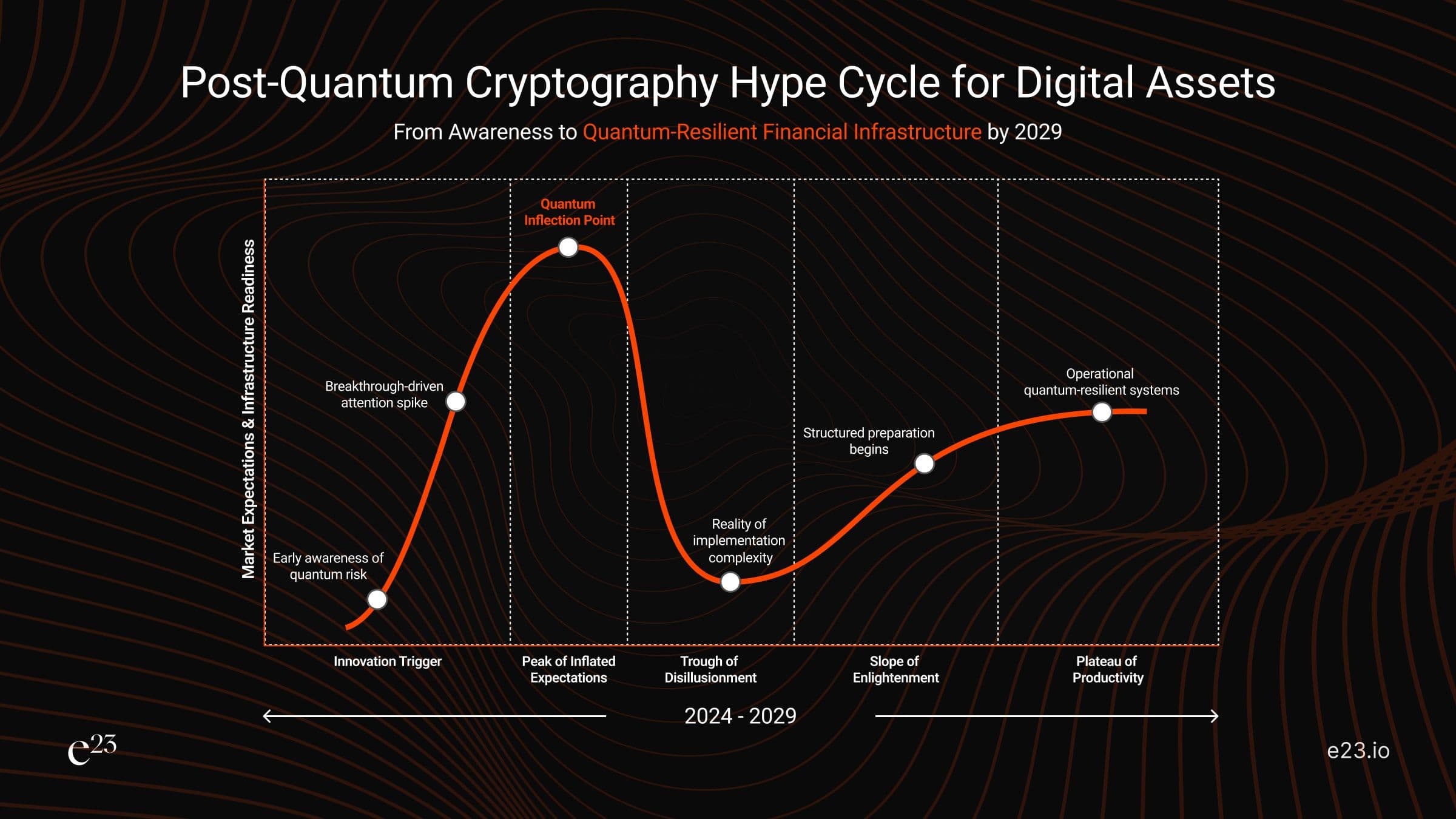
| Phase | What’s Happening | Strategic Focus |
|---|---|---|
| Innovation Trigger | Early awareness of quantum risk and ECC vulnerabilities | Build awareness, begin cryptographic inventory |
| Peak of Inflated Expectations | Breakthrough-driven shift in expectations and urgency | Reassess timelines, prioritise quantum risk at leadership level |
| Trough of Disillusionment | Realisation of migration complexity and system constraints | Avoid reactive upgrades, plan structured migration |
| Slope of Enlightenment | Structured preparation and system redesign begins | Implement modular cryptography, test PQC in production environments |
| Plateau of Productivity | PQC becomes operational and integrated into infrastructure | Deploy PQC-native systems, scale institutional-grade infrastructure |
Why This Matters
This research is a wake-up call for the entire blockchain ecosystem for several reasons:
| Massive asset exposure | Around 6.9 million BTC (roughly 32% of Bitcoin’s total supply) sit in addresses with exposed or reused public keys, making them vulnerable to “harvest now, decrypt later” (HNDL) attacks. Adversaries can already collect encrypted blockchain data today and decrypt it later once cryptographically relevant quantum computers (CRQCs) arrive. Similar risks apply to Ethereum and other chains relying on secp256k1. |
| Diverse and insidious attack surfaces | The threat goes far beyond dormant wallets. It includes: Real-time transaction hijacking (with modelled success rates high enough to compete with Bitcoin's 10-minute block time) Smart contract vulnerabilities Staking and consensus mechanisms Bridges Layer-2 solutions Public key sharing — a common practice in wallets and portfolio tools — creates new multi-key exposure risks in a post-quantum world |
| Systemic risk to trust and stability | A successful quantum attack on Bitcoin or Ethereum wouldn’t just drain individual wallets - it would also trigger widespread panic, capital flight, loss of confidence in DeFi, and cascading effects across the broader crypto economy. The paper notes potential indirect impacts on mining economics if trust erodes rapidly. |
| Urgency of preparation | Google’s 2029 internal deadline signals that waiting until a quantum computer is announced will be too late. Protocols and projects that delay PQC upgrades risk being left behind or facing emergency, high-cost migrations. |
This is a clear signal that the quantum era for blockchain is accelerating faster than many expected. What was once viewed as a distant theoretical risk is now a near-term planning reality.
The deeper implication is strategic: retrofitting legacy systems with quick patches will be painful and incomplete. True resilience requires treating crypto agility as the immediate bridge and PQC-native design as the long-term foundation. Projects that embed quantum resistance into their core architecture, rather than bolting it on later, will not only mitigate risk but also gain a competitive edge in an increasingly tokenised, institution-grade financial world.
What Should We Do Now: Immediate 2026 Action Plan
Seeing that the quantum threat is approaching, we propose the following practical and prioritized measures that blockchain infrastructures, protocols, and organizations should take as immediately as possible to build resilience and successfully navigate the post-quantum transition.
1. Prioritize Crypto Agility - Build the Bridge
Conduct a comprehensive cryptographic inventory across your entire stack - wallets, validator nodes, smart contracts, bridges, Layer-2 solutions, APIs, and off-chain systems. Identify every instance of ECDSA/secp256k1 and exposed public keys.
Refactor critical components to use modular cryptographic designs (abstract libraries, provider plugins, or modern HSM interfaces) so algorithms can be swapped without massive code rewrites. Integrate continuous testing and rotation into your DevSecOps pipelines. This step is the practical foundation that prevents the migration from becoming chaotic and expensive.
2. Establish Governance – Create a Crypto Center of Excellence (CryptoCoE)
Quantum readiness requires technical exercise and a strategic, cross-functional program that affects security, engineering, product, compliance, and business risk.
A Crypto Center of Excellence (CryptoCoE) is a dedicated working group that acts as the central command center for your post-quantum program. Its key responsibilities include:
- Maintaining a living cryptographic inventory and visibility dashboard
- Defining organization-wide cryptographic policies, standards, and migration priorities
- Coordinating hybrid PQC testing, performance benchmarking, and risk assessment
- Prioritizing systems based on HNDL exposure (e.g., long-lived cold wallets and staking contracts first)
- Aligning security, engineering, product, and leadership teams so everyone works from the same playbook
Establishing a CryptoCoE early prevents fragmented efforts, reduces duplication, and ensures steady progress toward the 2029 target. Many blockchain infrastructures and protocols are forming these teams today, including e23.
3. Launch Hybrid PQC Pilots (2026–2028)
Begin testing NIST-standardized post-quantum algorithms in real environments:
- ML-KEM (Kyber) for key exchange / key encapsulation
- ML-DSA (Dilithium) for digital signatures
Start with hybrid deployments (running classical algorithms like X25519 or ECDSA + PQC in parallel) in testnets and non-critical systems. Focus first on high-value, long-lived assets such as cold storage wallets, staking contracts, and tokenised real-world assets.
4. Design for Long-Term Quantum Resilience
Move beyond short-term fixes. Evaluate how to embed quantum resistance natively into your architecture - especially for new Layer-1s, tokenisation platforms, or major protocol upgrades. Innovations that treat PQC as a foundational design principle rather than a retrofit will have a significant advantage in the coming years.
5. Align Roadmaps and Monitor Progress
Support quantum-safe proposals in Bitcoin and Ethereum communities. Ensure your own development roadmap includes clear milestones for 2026 - 2029. Re-assess your cryptographic posture annually as hardware and algorithm standards continue to evolve.
Final Thought
Google Quantum AI’s March 2026 whitepaper reframed the expected timeline for quantum risk. What was previously considered a longer-term consideration is now increasingly within a 2029 planning horizon. The margin for preparation is becoming more defined.
This moves the discussion beyond theory. With secp256k1 potentially breakable using fewer than 500,000 physical qubits and attacks executable in minutes, the implications for blockchain systems are becoming clear. Billions in digital assets, smart contracts, staking mechanisms, and tokenised value all rely on cryptographic assumptions that will need to evolve.
The path forward requires clarity and decisiveness. Crypto agility serves as the essential bridge, giving teams the visibility, modularity, and operational flexibility needed to navigate the transition without chaos or massive rewrites. But the real strategic opportunity lies in going further: designing quantum-resilient blockchain systems from the ground up, where post-quantum cryptography is embedded as a foundational feature rather than a late-stage patch.
Organizations that treat 2026 as the year of serious preparation - through rigorous cryptographic inventories, modular refactoring, hybrid pilots, and forward-looking architecture decisions - will not only mitigate risk but position themselves as leaders in the next era of secure, institutional-grade decentralized infrastructure.
The next phase of blockchain infrastructure will be shaped by how these systems are designed to operate securely over time.
References
- Securing Elliptic Curve Cryptocurrencies against Quantum Vulnerabilities: Resource Estimates and Mitigations — Google Quantum AI, Ethereum Foundation, Dan Boneh (Stanford)